Who is involved
Historically, the Ambassador Bridge has been the dominant crossing between Michigan and Ontario, facilitating a significant volume of commercial and passenger traffic. For decades, it was the go-to route for truckers and travelers alike, symbolizing the robust trade relationship between Canada and the United States. However, recent developments have dramatically altered this landscape, leading to a surprising shift in cross-border traffic dynamics.
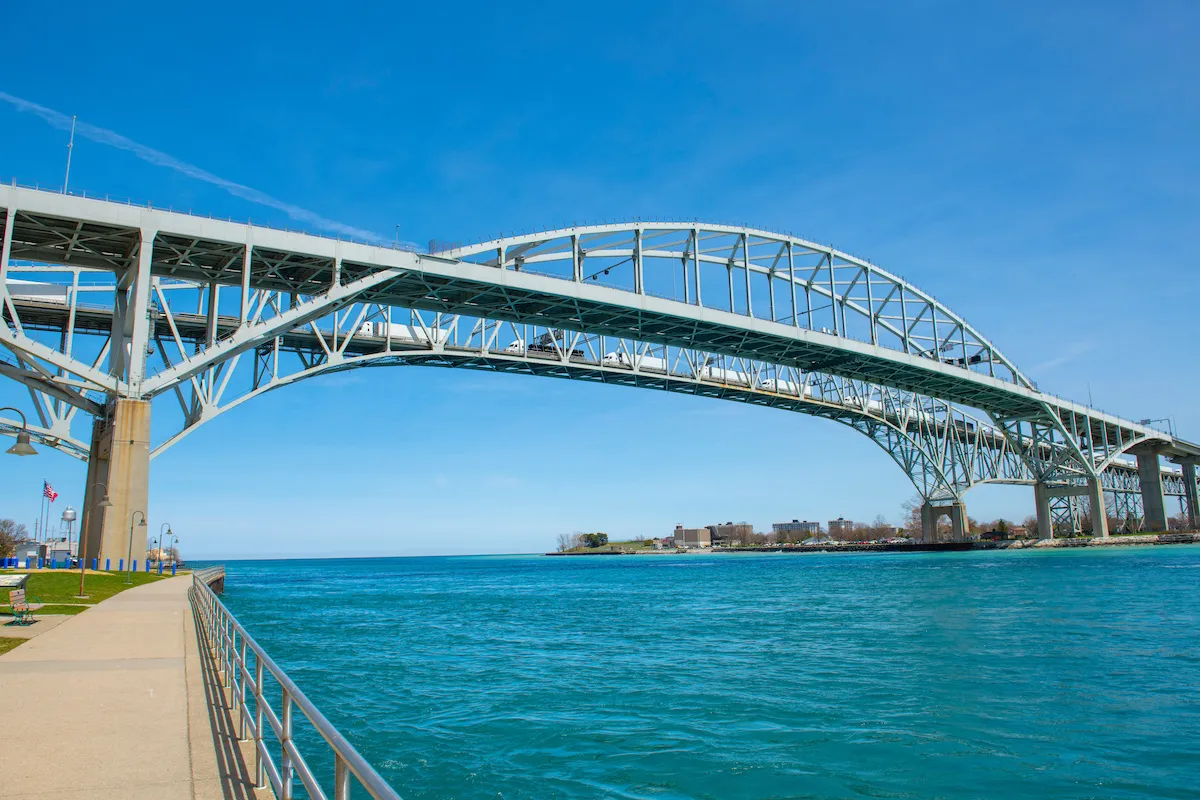
As of 2025, the Blue Water Bridge emerged as the leader in commercial vehicle crossings, recording over 2.1 million crossings compared to the 1.9 million at the Ambassador Bridge. This marked a significant change in expectations, as the Ambassador Bridge had long held the top position. The decisive moment came in early 2026, when the numbers continued to reflect this trend: in the first three months, the Blue Water Bridge recorded 531,732 commercial truck trips, while the Ambassador Bridge saw 496,796.
The shift in traffic patterns can be attributed to several factors, including the toll structure. The toll for commercial trucks at the Ambassador Bridge stands at $27 per axle, significantly higher than the $7 charged at the Blue Water Bridge. This price sensitivity has led many trucking companies to reconsider their routes, opting for the more economical crossing. As Stephen Laskowski of the Canadian Trucking Alliance noted, “Price sensitivity entered in the market for the supply chain,” highlighting how cost considerations are reshaping transportation choices.
Moreover, the Gordie Howe International Bridge, which is intended to further enhance cross-border connectivity, has faced delays and budget overruns, currently estimated to be about $700 million over its initial $5.4 billion budget. This uncertainty has left many stakeholders in limbo, further solidifying the Blue Water Bridge’s position as the preferred choice for commercial traffic.
In the first quarter of 2026, the Ambassador Bridge recorded 286,000 crossings, while the Blue Water Bridge had 299,000. This trend indicates a growing preference for the latter, as high tolls at the Ambassador Bridge have driven record commercial traffic through the Blue Water Bridge. Alexandre Gauthier remarked, “The Blue Water Bridge has surpassed all other international crossings in commercial traffic volume,” underscoring the significant shift in the cross-border transportation landscape.
Experts suggest that this change may have long-term implications for the Ambassador Bridge’s operational viability. As Matti Siemiatycki pointed out, “No one takes on risk for free,” indicating that the high costs associated with using the Ambassador Bridge may deter future traffic. The implications for the Bridge and Tunnel Operators Association and other stakeholders are profound, as they must navigate this new reality.
While the Ambassador Bridge still leads in passenger vehicle crossings, with 3.5 million compared to 1.6 million at the Blue Water Bridge, the commercial traffic shift is a critical development. Details remain unconfirmed regarding the future of the Gordie Howe International Bridge, but its uncertain opening date adds another layer of complexity to the situation.
As the landscape of cross-border traffic continues to evolve, the implications for trade, transportation, and regional economies will be significant. The Ambassador Bridge’s historical dominance is being challenged, and how stakeholders respond to these changes will shape the future of cross-border commerce between Canada and the United States.