Key moments
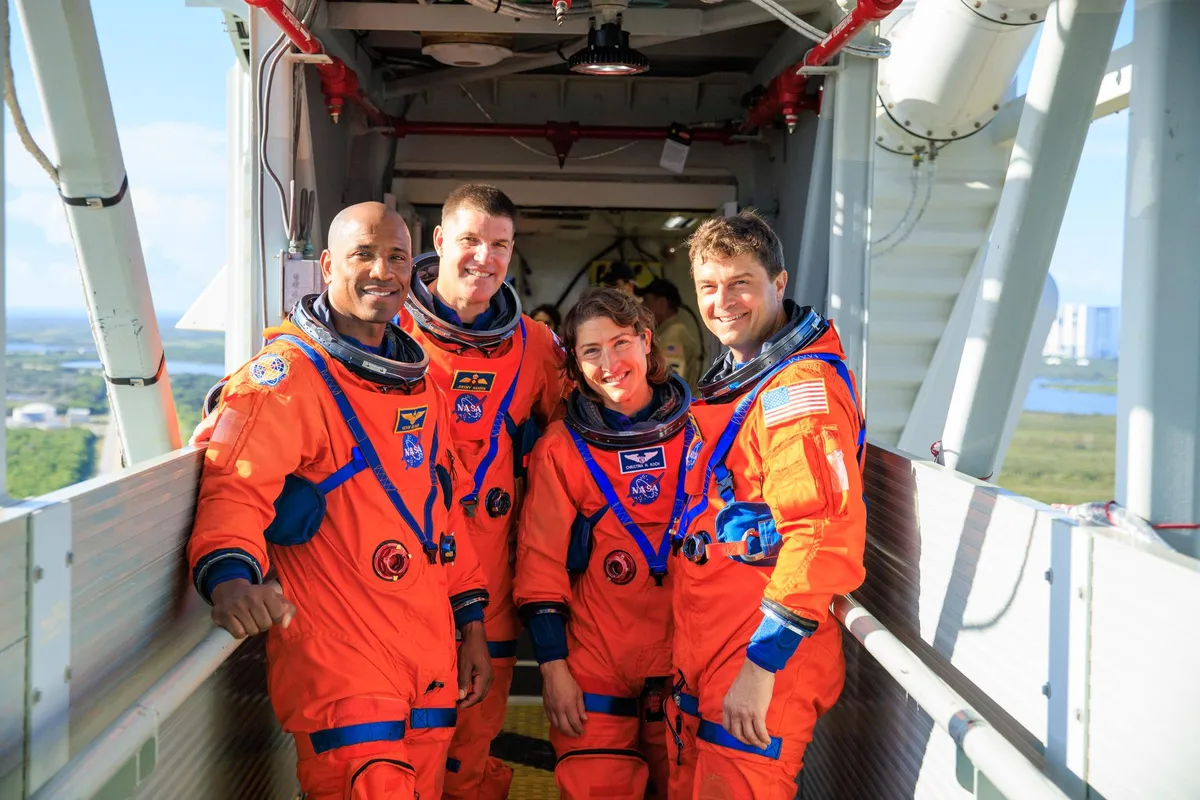
In a significant development for space exploration, NASA has announced the crew for its Artemis II mission, which is set to launch on April 1, 2026. The team consists of four astronauts: Reid Wiseman, who will command the mission, Christina Koch, Victor Glover, and Canadian astronaut Jeremy Hansen. This mission marks a pivotal moment as it will be the first time NASA’s Space Launch System rocket and Orion capsule carry human passengers, propelling them on a journey around the moon.
The Artemis II mission is designed to last ten days, during which the crew will swing around the moon, aiming to surpass the Apollo 13 distance record of 248,655 miles. This ambitious mission will take the astronauts farther from Earth than any human has gone before, reaching a distance of approximately 393,000 kilometers to the moon and an additional 5,000 miles beyond it.
Reid Wiseman expressed confidence in the mission, stating, “The four of us, we are ready to go. The team is ready to go. The vehicle is ready to go.” This sentiment reflects the extensive preparations that have gone into ensuring the success of Artemis II, which follows the uncrewed Artemis I flight that laid the groundwork for this historic endeavor.
Christina Koch, known for holding the record for the longest single spaceflight by a woman at 328 days, emphasized the significance of the mission, saying, “Success is Artemis 100, whenever that is.” Her experience will be invaluable as the crew conducts various science experiments and tests aboard the Orion capsule during their journey.
Victor Glover, who made history as the first Black astronaut to live and work aboard the International Space Station in 2020 and 2021, will serve as the pilot for this mission. His role is crucial as the crew navigates the complexities of space travel and the challenges that come with it. Meanwhile, Jeremy Hansen will become the first Canadian to venture to the moon, marking a milestone in international collaboration in space exploration.
The Artemis II mission is not just a technical achievement; it represents a new era of exploration. As Reid Wiseman noted, “We’ve always looked at the moon and said, ‘We’ve been there.’ But for this whole generation, for our generation, for the younger generation, for the Artemis generation, they’re going to look at the moon now and go, ‘We are there.’” This perspective underscores the mission’s potential to inspire future generations of explorers and scientists.
The mission is set to conclude with a splashdown in the Pacific Ocean, marking a return to Earth after a groundbreaking journey. NASA has ambitious plans for the future, with the Artemis IV mission scheduled to land astronauts on the moon in 2028, further solidifying its commitment to lunar exploration.
As excitement builds around the Artemis II mission, the anticipation of humanity’s return to the moon after more than five decades is palpable. The Artemis program aims not only to revisit our celestial neighbor but also to pave the way for future missions to Mars and beyond, ensuring that the spirit of exploration continues to thrive.