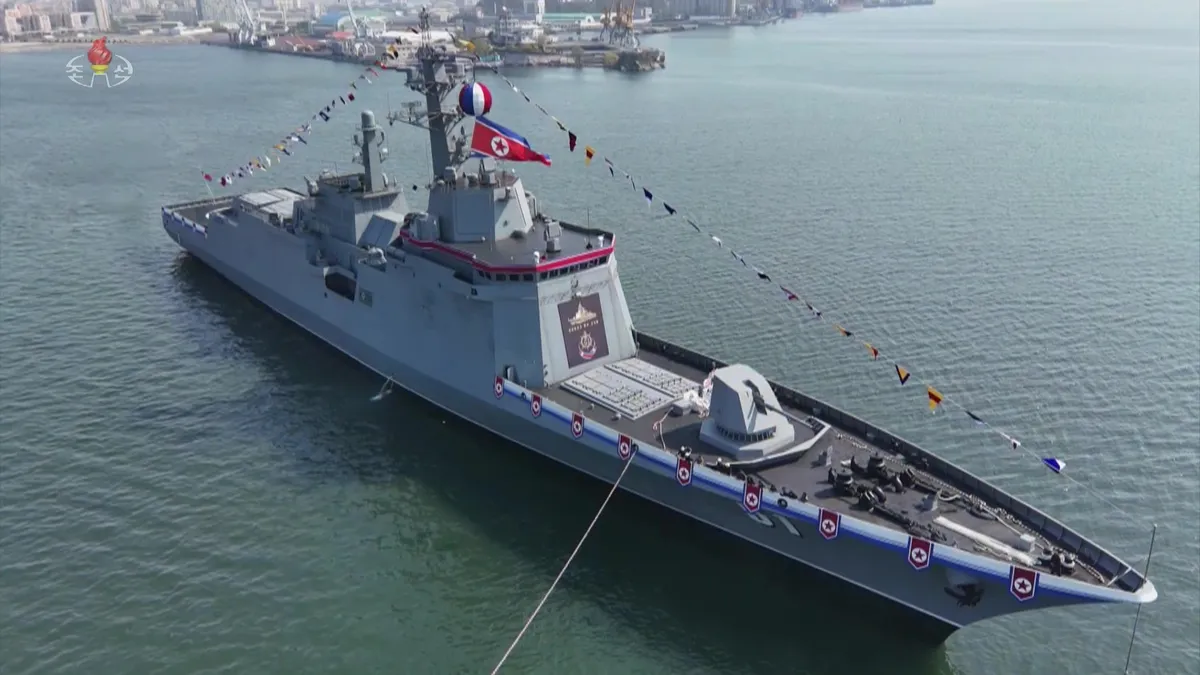
As tensions escalate on the Korean Peninsula, North Korea’s military advancements have taken center stage, particularly with the unveiling of the destroyer Choe Hyon. This 5,000-ton-class warship, first introduced in April 2025, has quickly become a symbol of the regime’s ambitions to bolster its naval capabilities amid deteriorating relations with South Korea.
On April 14, 2026, Kim Jong Un personally observed the launch of two cruise missiles and three anti-ship missiles from the Choe Hyon. The cruise missiles demonstrated impressive performance, flying for over two hours, while the anti-ship missiles maintained flight for more than 30 minutes. This display of military prowess underscores the North’s commitment to enhancing its operational reach and preemptive strike capabilities.
Kim Jong Un has hailed the development of the Choe Hyon as a significant milestone in expanding North Korea’s military capabilities. He emphasized the importance of the destroyer in strengthening the country’s nuclear war deterrent, stating that the government remains focused on the “limitless expansion” of its nuclear forces. This rhetoric aligns with North Korea’s broader strategy to assert itself as a formidable military power in the region.
The Choe Hyon is designed to carry a range of advanced weaponry, including anti-air and anti-ship systems, as well as nuclear-capable ballistic and cruise missiles. This multi-faceted capability positions the destroyer as a key asset in North Korea’s naval strategy, particularly as the nation plans to construct two additional destroyers in 2026. These developments suggest a shift towards forming a more cohesive destroyer flotilla rather than deploying isolated platforms.
In a broader context, the construction of the Choe Hyon and the planned expansion of North Korea’s naval fleet come at a time of heightened military tensions with South Korea. The regime’s military enhancements are viewed as a direct response to perceived threats from its southern neighbor, further complicating the security landscape in the region.
Experts have noted that the mention of additional destroyers indicates an acceleration in North Korea’s naval capabilities. Lim Eul-chul, a prominent analyst, remarked that this strategy reflects a desire to create a more integrated naval force, which could alter the balance of power in the region. The implications of such advancements are significant, as they may provoke a military response from South Korea and its allies.
As North Korea continues to develop its military assets, the international community watches closely. The Choe Hyon’s capabilities, particularly its ultra-precision cruise missiles, could change the dynamics of naval warfare in the region. With Kim Jong Un’s emphasis on expanding military capabilities, the potential for increased provocations remains a concern.
In summary, the Choe Hyon destroyer represents a pivotal moment in North Korea’s military evolution. As the regime pushes forward with its naval ambitions, the implications for regional security and stability are profound. The world will be watching how these developments unfold in the coming months.