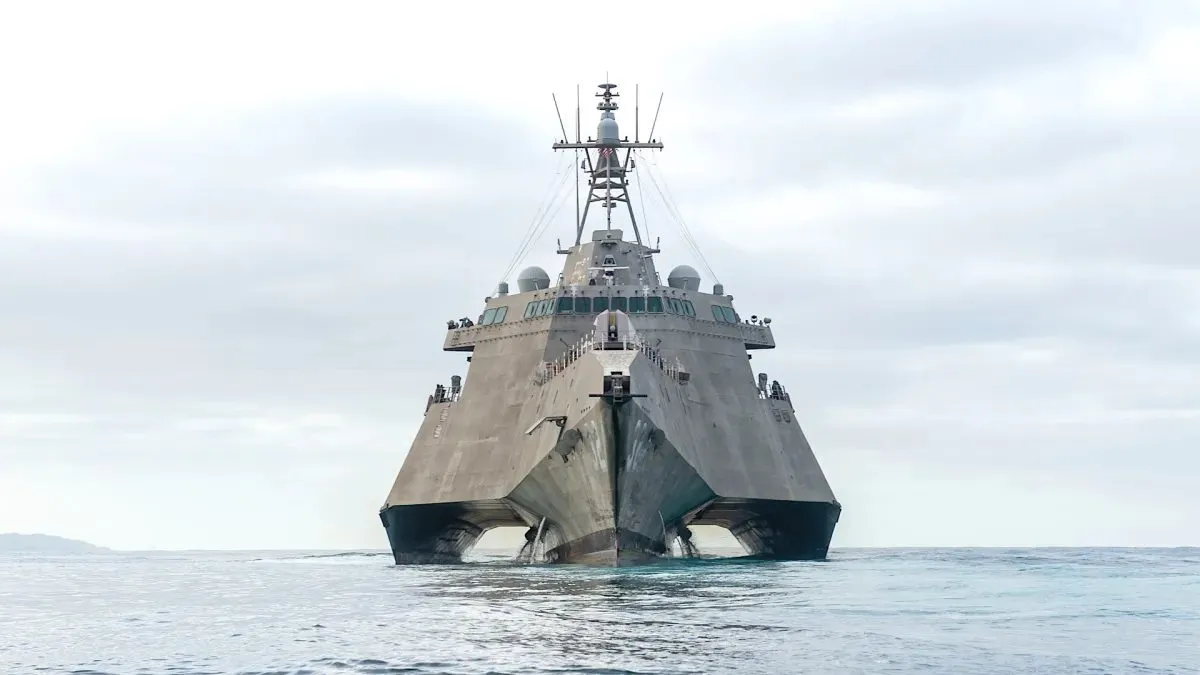
The USS Tulsa and USS Santa Barbara, two Independence-class Littoral Combat Ships equipped with minesweeping capabilities, were photographed at the North Butterworth Container Terminal in Malaysia on March 15, 2026. This marks a significant redeployment as both ships had previously been stationed in the Middle East to counter Iranian naval mine threats.
Prior to their arrival in Malaysia, the USS Tulsa was in port in Bahrain as recently as February 9, 2026, while the USS Santa Barbara was operating in the Persian Gulf on January 30, 2026. Their current presence in Malaysia raises questions about the U.S. mine countermeasures strategy in the Persian Gulf, particularly amid ongoing Iranian attacks on commercial shipping in the Strait of Hormuz, through which 20% of global oil transit occurs.
Equipped with towed mine-hunting sonar systems and Common Unmanned Surface Vehicles (CUSV) for mine sweeping operations, both ships are configured for mine countermeasure missions. The timing of their deployment is striking, especially given that Iranian attacks have virtually halted maritime traffic through the Strait of Hormuz.
On March 10, U.S. forces eliminated 16 Iranian minelayers, a move that underscores the heightened tensions in the region. However, the absence of dedicated mine countermeasures vessels from the Persian Gulf region could signal either confidence that the immediate mine threat has diminished or that alternative countermeasures are being deployed.
The current location of a third ship, the USS Canberra, remains unknown, raising further questions about U.S. naval strategy in the area. Observers have noted that the redeployment of these ships has caught regional security analysts by surprise.
Details remain unconfirmed regarding whether any replacement mine countermeasures vessels are being sent to fill the gap in Middle East coverage or the exact reasons for the rapid redeployment of the ships. The situation continues to evolve as the U.S. Navy reassesses its operational posture in response to regional threats.