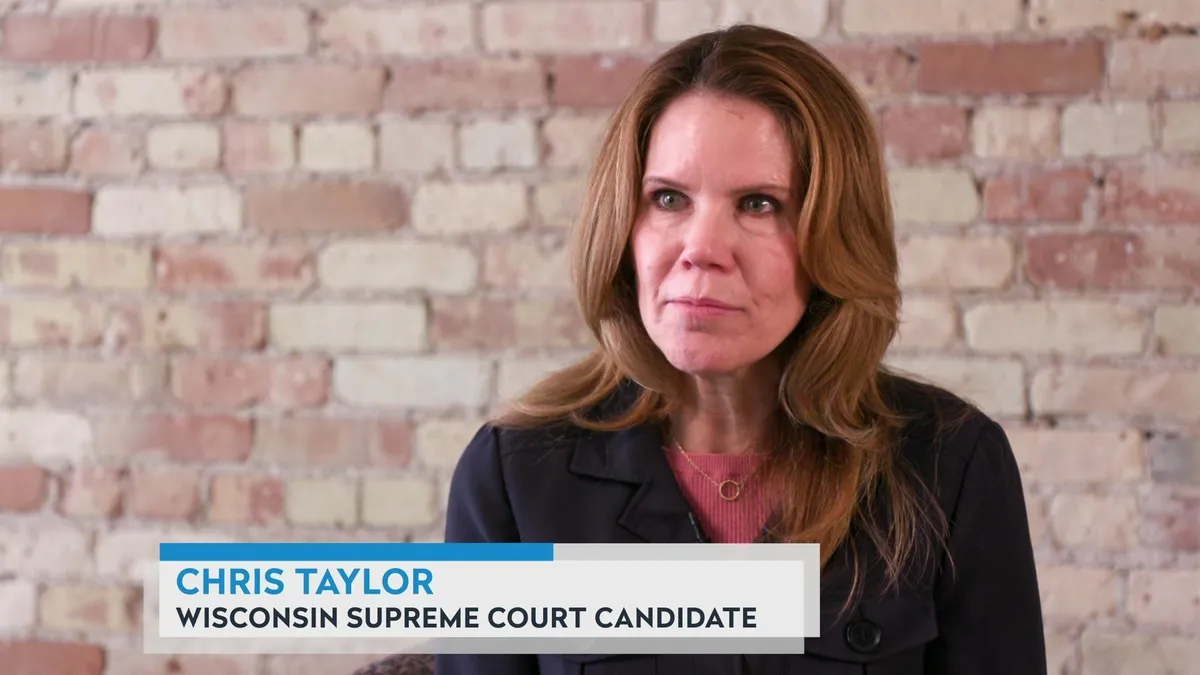
“I think what came out of the debate was just a real contrast between myself and my opponent,” stated Chris Taylor, a key figure in the upcoming Wisconsin Supreme Court election scheduled for April 7, 2026. Taylor, who currently serves as a judge on the Madison-based District 4 Court of Appeals, is positioning herself as the liberal candidate in a race that could significantly impact the court’s ideological balance.
With the current Wisconsin Supreme Court holding a 4-3 liberal majority, Taylor’s victory could expand this majority to 5-2, a prospect that has garnered significant attention. In contrast, her opponent, Maria Lazar, a judge on the Waukesha-based District 2 Court of Appeals, is viewed as the conservative candidate. If Lazar prevails, the existing majority will remain unchanged.
As the election approaches, campaign financing has become a focal point. Taylor has raised approximately $6.2 million for her campaign, significantly outpacing Lazar, who has raised about $1.2 million. This financial disparity reflects the heightened stakes of this election, which is the only statewide race on the ballot.
Early voting turnout has been notably lower compared to previous elections, with only 324,000 early ballots returned so far. This decline in participation raises questions about voter engagement as the election date nears. Charles Franklin, a political analyst, noted, “The majority is not up for grabs, so political actors – especially out of state — are not engaged in the race.”
The candidates recently faced off in a debate held on April 2, 2026, where Taylor accused Lazar of dishonesty, stating, “My opponent, point blank, lied.” Such accusations highlight the contentious nature of the campaign and the contrasting visions for Wisconsin’s judiciary.
Melissa Moore Baldauff, a supporter of Taylor, emphasized the importance of this election, asserting, “After ending the conservative stranglehold on our judiciary, Wisconsinites have gotten used to having a fair and independent state Supreme Court that protects the constitutional rights of all Wisconsinites and keeps extremists in check.”
As the election date approaches, the dynamics of this race will continue to evolve, with both candidates likely to ramp up their efforts to sway undecided voters. The outcome will not only determine the composition of the Wisconsin Supreme Court but also influence the broader political landscape in the state.
Details remain unconfirmed.